
A Turning Point for Legal Migration in Sierra Leone
Yeama Sarah Thompson
4/12/20263 min read
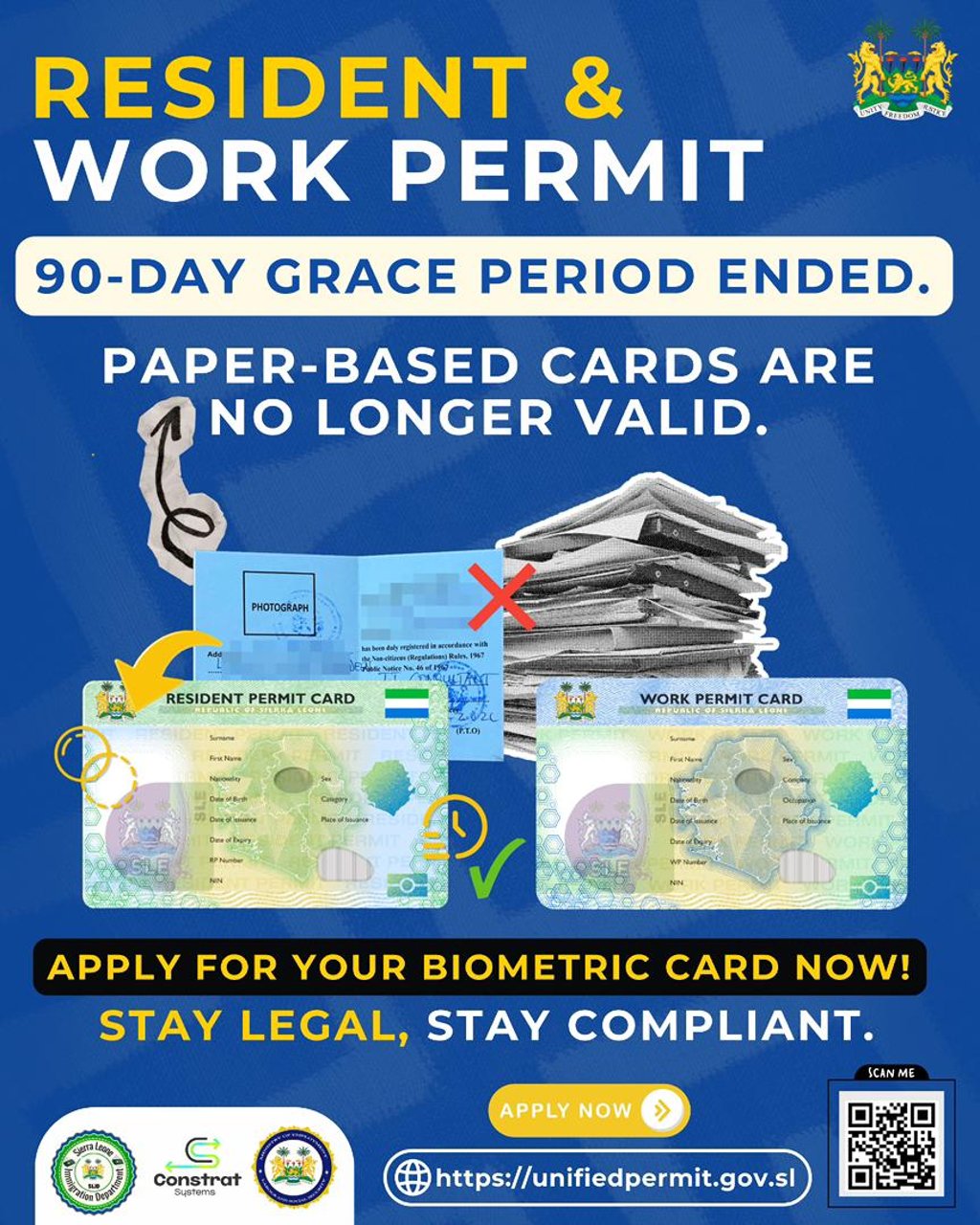
Sierra Leone has, for decades, managed migration through a fragmented, manual, and vulnerable system to abuse. Work permits were processed separately from residence permits. Paper-based documentation could be delayed, duplicated, or, in some cases, manipulated. Enforcement was inconsistent, and data on non-citizens remained incomplete.
That era is ending.
The rollout of the Unified Resident and Work Permit system marks a decisive shift not just in administration, but in how Sierra Leone understands and governs legal migration. This is not a cosmetic reform. It is structural. And its implications are far-reaching.
But transitions of this nature are rarely comfortable for everyone. For some, the new system feels tedious, more demanding, less flexible, and at times frustrating in its early phases. That frustration is not incidental; it reflects a deeper shift in power.
The old paper-based regime created space for discretion and, in some cases, quiet advantage. Expired permits could linger. Errors could be negotiated. Intermediaries found value in navigating opacity. Those who had mastered that system whether individuals or networks are now confronted with a process that is standardised, traceable, and far less forgiving. What is now described in online threads as “slow,” “stressful,” or “too rigid” is often the discipline of compliance replacing the convenience of loopholes.
A scan through conversations on the Unified Permits SL Facebook page reflects this dual reality. Some users have complained about delays in card issuance, difficulties navigating the online portal, or uncertainty about timeline concerns that are not unusual in the early stages of any digital transition. Others, however, have acknowledged the benefits: the end of “backdoor processing,” clearer procedures, and the assurance that “everything is now in one place and traceable.”
This tension between discomfort and progress is precisely where reform lives.
At its core, the system resolves a long-standing institutional disconnect. The Ministry of Employment, Labour and Social Security and the Sierra Leone Immigration Department now operate through a unified digital platform. A work permit is no longer treated as an isolated authorization; it is intrinsically linked to legal residency. This alignment closes one of the most exploited gaps in migration governance.
The impact on legal migration is immediate.
The system introduces credibility through biometric identification. It enforces clarity by moving all applications online “no paperwork, no bureaucracy,” as official messaging has repeatedly emphasised. It strengthens data integrity, enabling the state to maintain a real-time registry of non-citizens. And critically, it enhances fairness ensuring that access to legal status is determined by process, not proximity to influence.
It is also important to acknowledge the leadership behind this shift. Under the stewardship of Mohamed Rahman Swaray, the reform has been consistently framed as a modernization imperative rather than a punitive exercise. His position has been clear and deliberate: “This is about strengthening systems that are transparent, efficient and accountable.”
That framing matters. It situates enforcement within a broader logic of state-building, not control for its own sake.
The reform also recalibrates responsibility. Employers are now expected to verify the status of their workforce. Compliance is no longer optional or peripheral it is central. Migration governance, in this sense, becomes a shared obligation between the state, the private sector, and migrants themselves.
Of course, the friction is real. Delays in processing, technical bottlenecks, and public uncertainty are evident in online feedback and everyday conversations. But these are transitional pains, not structural weaknesses. Every system that replaces discretion with discipline goes through this phase.
What matters is the trajectory.
The enforcement phase now underway should be understood in that light. It is not abrupt; it follows a clearly communicated transition from the January 2026 digital rollout to the March 2026 end of the grace period. The message is firm but predictable: the system is now operational, and compliance is expected.
Ultimately, the Unified Resident and Work Permit system is about more than documentation. It is about order replacing ambiguity, data replacing guesswork, and rules replacing discretion.
Sierra Leone is not closing its doors. It is defining how those doors are entered lawfully, transparently, and in alignment with national priorities.
For those who thrived in the old system, this may feel like loss. For the country, it is progress.